

Estimating the Total Cost of Compressed Air
| 20 November, 2024BENEFITS OF ESTIMATING THE TOTAL COST OF COMPRESSED AIR
It is important to understand the cost of compressed air in your facility. Many people think that compressed air is free, but it certainly isn’t. Due to its cost, compressed air is considered a fourth utility in manufacturing plants. In this blog, I will show you how to calculate the compressed air cost analysis. Then, you can use this information to assess the need for Smart Compressed Air products.
Types of Air Compressors
There are two types of air compressors: positive displacement and dynamic. Both have an electric motor that spins a shaft. Positive displacement types use the motor’s energy and the shaft to change the volume in an area, like a piston in a reciprocating compressor or rotors in a rotary compressor. Dynamic types use the motor’s energy and the shaft to create speed energy with an impeller. For electric motors, power is measured in kilowatts (KW) or horsepower (hp). As a conversion unit, 1 hp is equal to 0.746 KW.

Determine the Total Compressed Air Cost Estimation
Electric companies charge per kilowatt-hour (KWh), so we can determine the energy cost of running electric motors. If your air compressor is rated in hp, you can use Equation 1:
**Equation 1:**
hp * 0.746 * hours * rate / (motor efficiency)
where:
– hp – horsepower of the motor
– 0.746 – conversion to KW
– horas – hours – operating time
– rate – electricity cost, KWh
– motor efficiency – the average for an electric motor is 95%.
If the air compressor’s motor is in kilowatts (KW), the previous equation simplifies, as shown in Equation 2:
**Equation 2:**
KW * hours * rate / (motor efficiency)
where:
– KW – kilowatts of the motor
– hours – operating time
– rate – electricity cost, KWh
– motor efficiency – the average for an electric motor is 95%.

For example, a plant operates 250 days a year in 8-hour shifts. The compressor’s cycle time is approximately 50% on and 50% off. To calculate the operating hours, we have 250 days at 8 hours/day with a 50% duty cycle, or 250 * 8 * 0.50 = 1,000 operating hours per year. The air compressor they have is a 100 hp rotary screw compressor. The electricity rate in this facility is $0.08/KWh. With these factors, the annual cost is calculated using Equation 1:
100 hp * 0.746 KW/hp * 1,000 hr * $0.08/KWh / 0.95 = $6,282 per year.
In both equations, you can substitute your information to see how much you’re paying annually to generate compressed air at your facility. This process is part of compressed air cost analysis and helps understand the total cost of ownership compressed air.
The type of air compressor affects the amount of compressed air that can be produced with the electric motor. Typically, the production rate is expressed in cubic feet per minute per horsepower (CFM/hp). Positive displacement types have different values depending on the efficiency of their design. For a single-acting piston air compressor, the amount of air is between 3.1 and 3.3 CFM/hp. So, if you have a 10 hp single-acting piston, you can produce between 31 and 33 CFM of compressed air. For a 10 hp double-acting piston, it can produce between 4.7 and 5.0 CFM/hp. As you can see, the double-acting compressor produces more compressed air with the same power.
Rotary screw compressors produce between 3.4 and 4.1 CFM/hp. Dynamic-type compressors produce approximately between 3.7 and 4.7 CFM/hr. If you know the type of compressor you have, you can calculate the amount of compressed air you produce per horsepower. On average, EXAIR uses 4 CFM/hp when talking to customers who want to know the overall performance of their compressor.
With this information, we can estimate the compressed air system cost estimation to generate compressed air as shown in Equation 3:
**Equation 3:**
C = 1000 * Rate * 0.746 / (PR * 60)
where:
– C – Cost of compressed air ($ per 1000 cubic feet)
– 1000 – Scale factor
– Rate – electricity cost (KWh)
- 0.746 - conversion from hp to KW
– PR – Production Rate (CFM/hp)
– 60 – conversion from minutes to hours
So, if we take the average of 4 CFM/hp and an average electricity rate of $0.08/KWh, we can use Equation 3 to determine the average cost to generate 1000 cubic feet of air.
C = 1000 * $0.08/KWh * 0.746 / (4 CFM/hp * 60) = $0.25/1000ft³.


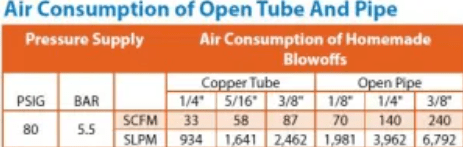
Once you have the cost of compressed air, you can identify areas where you can start saving. One of the biggest efficiency problems is the use of blowers with open tubes. This includes cheap air guns and perforated holes in pipes. These are very inefficient for compressed air use and can generate high costs. I will share a comparison of a 1/8″ NPT pipe with an EXAIR. Mini Air Nozzle. As you’ll see, by adding the EXAIR nozzle to the end of the pipe, the company saved $1,872 per year, which is a significant saving and part of reduce compressed air operating costs and energy savings compressed air audit.

Compressed Air Savings
Generating compressed air is costly, so you should use it as efficiently as possible. With the previous equations, you can calculate how much you’re paying. This information will allow you to make informed decisions and find areas where savings can be achieved. As in the previous example, focusing the blowing systems in a facility is a quick and easy way to save money. If you need help improving the efficiency of your compressed air system, contact an AIRTEC Engineer. This is part of compressed air cost analysis, which helps identify areas to reduce compressed air operating costs.
Thanks to modern compressed air, technology solutions, companies have access to truly innovative products and solutions.
How does Airtec help you?
At Airtec Servicios, we have many years of experience in using these EXAIR products , and our technicians are specialists in installation and reporting, which is why we have many satisfied customers. This experience also enables us to perform accurate compressed air system cost estimation and identify opportunities to reduce compressed air operating costs.
CONTACT US! Our experts will provide the best alternative for your company, focusing on the total cost of ownership compressed air and energy savings compressed air audit.