Sensor Technologies Used in Dew Point Transmitters (Advantages/Disadvantages)
| 22 June, 2024Have you ever been told about the sensor technologies used in dew point transmitters? Have you ever had a faulty dryer in your compressed air system that ruined your production, and it wasn’t noticed until it was too late? Dry compressed air is one of the most important quality parameters when it comes to process safety. When ambient air is compressed, the proportion of moisture relative to the air volume increases drastically. Therefore, the higher concentration of moisture in compressed air leads to a higher dew point temperature, and the moisture is more likely to condense at higher temperatures.
What could be worse than having water droplets in your compressed air pipes, which can lead to machinery failures, process contamination, or even cause blockages?
Using a dew point instrument, known as a dew point analyzer or dew point meter, will help users operate a safe and reliable compressed air system by notifying them early in case of alarms. This article provides a brief overview of the sensor technologies used in dew point transmitters, reviewing their advantages and disadvantages when used in measurement equipment.
Introduction
The dew point describes the temperature at which water vapor in the air begins to condense. Typically, the dew point temperature (Td) under normal pressure and ambient temperature conditions is around 54 – 57°F (12-14°C) Td. We’ve all experienced this phenomenon in our daily lives. Take a cold drink out of the fridge on a warm summer day, and within seconds, water droplets begin to form on the surface of the can or bottle. The reason is that the cold drink has cooled the surrounding air, causing its water vapor to condense on the surface of the container as the dew point temperature is reached.
It’s more common to refer to the temperature described above as the dew point, dew point pressure, or dew point temperature. However, when temperatures are below 32°F (0°C) Td, the correct term would be frost point instead of dew point. Over the past twenty years, the term dew point and dew point meter has been used and accepted, where frost point sensor or frost point meter would be the strictly correct term but is not commonly used in the industry.
Sensor Technologies to Measure Water Vapor (Humidity/Dew Point Temperature) in Compressed Air
There are several technologies used to measure the amount of water vapor in compressed air or gases. Many of them are compact and reliable solutions, while others come with costly installation requirements and the tendency to lose accuracy over time. Cooled mirrors set the standard for humidity measurement with a very high degree of precision, but these cooled mirrors are relatively expensive and not easy to use, especially in field and portable applications. Therefore, cooled mirrors are more likely to be used as reference meters in calibration labs or similar facilities, where high precision is required.
The most common types of dew point transmitters used in dew point sensors are electrical sensors that change their electrical characteristics in proportion to the presence of water vapor and offer typical accuracies of +/- 2°C Td. The most well-known are polymer sensors, quartz crystal microbalance sensors, and metal oxide sensors. In this document, we will briefly discuss these three types of sensors to highlight their advantages and disadvantages. Understanding the dew point sensor pros and cons of each type helps in selecting the right technology for the specific application.
Metal Oxide Sensors
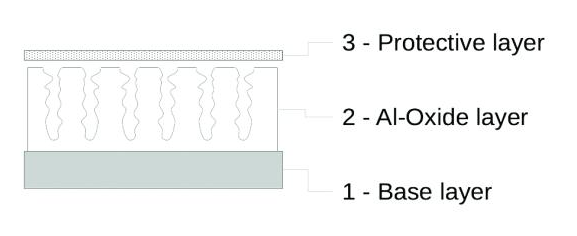
There are many variations in the design of this type of sensor, but the most common is the aluminum oxide sensor, which basically consists of two layers, or sometimes three layers.

The first layer is commonly an aluminum surface that forms the base layer on which the second layer, in the form of aluminum oxide, is applied through chemical processes. Some sensors offer a third layer, which acts as a protective layer in the form of high-quality porous metals.
The simplified operating principle can be described as the water molecules traveling towards the Al-Oxide layer and staying there as water vapor molecules. The water molecule now changes the total capacitance of the sensor element. Since the Al-Oxide gaps act as a matrix of multiple capacitors, the electrical capacitance changes when water molecules enter the space between the individual gaps. This change can be measured and used to calculate the corresponding humidity present, utilizing humidity and dew point measurement sensors.
The main advantage of this type of sensor is that they are relatively inexpensive to manufacture, can be developed into a small-sized sensor element, and can be used over a wide pressure range, making them a good choice for types of dew point transmitters.
The disadvantage of these sensors is their slow response time and their relatively high drift over time. The main issue is the structure of the Al-Oxide surface, which is prone to trapping dust or other particles, and progressively clogging over time.
These types of sensors are known to offer good accuracy when deployed, but due to the reasons mentioned above, the accuracy drifts over time, especially if used in conditions where there is slight contamination. This is a common concern in dew point sensor pros and cons when using these sensors in practical applications.
While these sensors show good response time for dry-to-wet measurements, the response time from wet-to-dry is significantly slower. The microscopic roughness of the Al-Oxide surface does not release the water molecules easily, making them a poor option for systems with fast changes, especially in portable use. Due to the drift, which is around 2°C Td per year, these sensors need to be maintained and calibrated much more frequently than other technologies. This is one of the reasons why performing a dew point transmitter technology comparison can be useful when evaluating different sensor options for specific applications.
**Advantages**
- Cheap to manufacture
- Fast dry-to-wet response time
- Small size
- Wide pressure range
**Disadvantages**
- Slow wet-to-dry response time due to structural roughness
- Drift over time
- Highly sensitive to contamination
- Frequent calibration required
Polymer Sensors
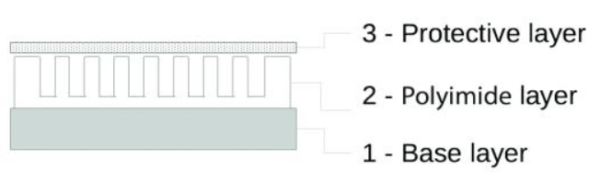
Polymer sensors are very similar to the principle used in aluminum oxide sensors, but they have a key difference in terms of the sensor structure.

Polymer sensors are built in three layers; the base structure acts as an isolated substrate, the second layer of polyamide measures the humidity, and finally, a protective layer is placed on top.
To describe the simplified operating principle, it can be said that the protective layer is made of a porous material that acts as a filter. This layer only lets water molecules pass through, while larger impurities cannot enter the polymer layer. The water molecules then change the electrical capacitance of the sensor element, similar to the principle described for the aluminum oxide sensor. The change in capacitance is electrically measured and is proportional to the presence of moisture within the sensor element and, therefore, in the surrounding air, using humidity and dew point measurement sensors.
The main advantage of the polymer sensor comes from the physical structure of the polymer layer. The uniform surface makes it easy for water molecules to enter and also be released, and the molecules do not get trapped easily. This results in a very fast response time in either direction, both from dry to wet and from wet to dry, which is ideal for applications where dew point sensor technologies are critical.
Another advantage is that the sensors are highly resistant to contamination, and there is almost no drift, as the polymer is unlikely to age or change its structure, even when exposed to high humidity. These features are often highlighted in dew point sensor pros and cons when comparing this technology with others.
The drawback of these sensors is their loss of sensitivity in low-humidity applications. More commonly, polymer sensors are used to measure dew points up to -76°F (-60°C) Td. Below this point, the sensitivity decreases massively, resulting in inaccurate readings.
**Advantages**
- Improved resistance to contamination due to structure
- Fast dry-to-wet and wet-to-dry response times
- Nearly no aging and/or drift
- Wide pressure range
**Disadvantages**
- Not suitable for low-humidity applications
- Inaccurate below -76°F (-60°C) Td
Quartz Crystal Microbalance (QCM) Sensors
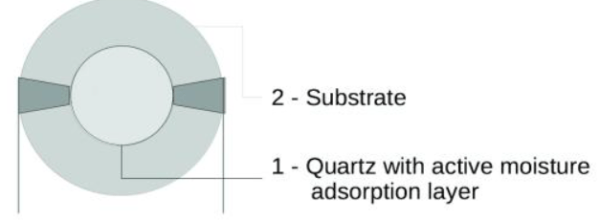
Quartz crystal microbalance (QCM) sensors are built with a quartz substrate as the base and are covered with a thin film of an active moisture adsorption layer. Their measurement principle is based on the change in mass of the oscillating quartz due to the additional mass of water molecules, which directly alters the oscillation frequency.

When a voltage is applied, the quartz begins to oscillate at a resonance frequency. If the sensor is exposed to compressed air or gases containing moisture, water molecules are adsorbed by the thin coating layer on the sensor’s surface. By adsorbing the water molecules, the mass of the sensor changes, and simplified, as it becomes heavier by adding the mass of water molecules to the total mass, the resulting oscillation frequency will be different from when no molecules are present.
Based on this, in theory, a QCM sensor can detect a single water molecule present in the sensor’s adsorption layer. Of course, it depends heavily on the electrical circuit used to apply the oscillation voltage and evaluate the frequency change.
The main advantage of these sensors is their high precision in very low-humidity applications, where other sensor principles have disadvantages in terms of sensitivity.
At the same time, QCM sensors have moderately fast response times in wet-to-dry applications, thanks to the high water adsorption polymer layer.
The disadvantages of QCM sensors are their limitation in not being used in humidity applications where dew points need to be measured across the full range, from -148 to 122°F (-100 to 50°C) Td. The microbalance is typically designed to have a stable frequency in relation to the thickness of the moisture adsorption layer. To design a sensor with high sensitivity in low-humidity environments, the layer thickness needs to be thin to achieve a stable frequency and a noticeable mass change. But this layer thickness limits the ability to adsorb more water molecules and, therefore, limits the ability to measure higher dew points.
As the adsorption layer becomes saturated at higher humidity levels, there is a physical limit to measuring higher humidity concentrations. If the thickness of the adsorption layer were increased, low-range dew point measurements would not show a significant mass change. Therefore, in designing QCM sensors, a trade-off must be made, either having a thin layer for measuring low humidity or a thicker layer for measuring higher humidity, but losing precision at the lower end. Typically, a QCM sensor is designed to measure in low-humidity applications.
Another limitation is their use in high-pressure applications. QCM sensors lose accuracy when used in high-pressure applications above 1.6 MPa(g) or more, as the compressed gas dampens the quartz’s ability to oscillate.
Conclusion
The technologies described, aluminum oxide sensors and polymer sensors, are the most commonly used sensors in dew point meters available on the market and are well-suited for standard humidity measurement applications. QCM sensors are much less common, as they are used in high-tech applications where precise low-humidity measurements are needed.
Aluminum oxide sensors’ greatest disadvantage is their sensitivity to contamination, and their physical structure tends to age and, therefore, drift over time.
Polymer sensors are the most robust, offering high accuracy and long-term stability, but at the same time, they are not suitable for low-humidity applications.
Sensor Technology Used in SUTO iTEC Dew Point Meters
For standard applications, SUTO iTEC relies on polymer sensor technology in their dew point meters. They offer fast response times and good accuracy in applications where dew points range between -76 and 122°F (-60 to +50°C) Td, making them optimal for monitoring refrigerated and desiccant compressed air dryers.
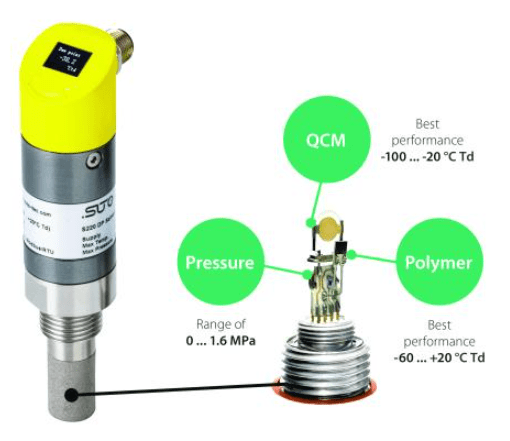
For high-tech applications, the company combines two sensor technologies in a single dew point meter. Their unique sensor solutions combine the QCM sensor with the polymer sensor in a single measurement unit, offering the advantages of both sensors and eliminating the disadvantages of each sensor technology. The sensor automatically switches to the most appropriate sensor element based on the current conditions and range, as demonstrated in dew point transmitter technology comparison.

With this unique design, the company is able to offer a dew point sensor capable of accurately and reliably measuring the full range of dew point temperatures, down to -148°F (-100°C) Td.
Additionally, the dew point sensors feature an integrated pressure sensor. By adding a pressure sensor to the measurement device, users are enabled, first and foremost, to measure the system pressure, which is a key indicator of any compressed air system. This also allows them to convert the measurement output to other humidity units on the fly, for example, to measure ppm(v), absolute humidity, and many other units that depend on pressure. This makes this dew point sensor one of the most versatile sensors on the market.
Thanks to modern compressed air technology solutions, companies now have access to truly innovative solutions and products.
How Airtec Helps You?
At Airtec Servicios, we have many years of experience using these SCADAR systems, and our technicians are specialists in installation and reporting, so we have many satisfied customers.
CONTACT US! Our experts will provide you with the best solution for your company.